Where we are is horrible steep
I've never played Peak. With friends I know, or otherwise. I've read about it. I've read King Lear many times since I first read it in the intensely pandemic times for a Zoom class. And I've played it. Well. Not in the usual way one plays plays. I've played it in a game way, I mean.
I didn't think I'd be writing something for Critical Distance's Blogs of the Round Table: Friendslop, since I'm so out of practice writing essays. But after browsing the social media tag, and reading this post from exalclaw.com and then subsequently this post from ashlikeadragon at bearblog, I smashed out a lot of this post's first draft while waiting for a bus.
This post discusses a disturbing scene in Shakespeare's tragedy play King Lear.
- In summary: description of depression thoughts; mention of graphic violence done to and attempted death of a fictional parent by suicide.
- Specifically: briefly summarizing how Gloucester was blinded via his eyes being gouged out in Act 3 Scene 7, and talking around his subsequent voiced suicidal intentions as introduced in Act 4 Scene 1 and resolved (he lives) in Act 4 Scene 6.
I've never played Peak. With friends I know, or otherwise. I've read about it.
I've read King Lear many times since I first read it in the intensely pandemic times for a Zoom class. And I've played it.
Well. Not in the usual way one plays plays.
I've played it in a game way, I mean.
...since the co-op, “Friday night with the squad” vibe is the most integral component of the [friendslop] genre.
(Lotus's essay)
On behalf of newly French Queen Corbeelia, the Bears introduced themselves and their "god I hate you for that pun" names. One of them claimed he had a Sub-bear-u vehicle. I said something like, "haha! nice try but to prevent my own insanity, let's stick to period technology," and let him have a full masted ship. (Courtesy of the Queen, of course.) Two others slammed together two carts to make some boat side-cars to the actual proper ship. Off they went!
The Bears sped across the channel from Calais to land at the cliffs of Dover. One bear in the group (special ability: Climb) did the normal thing. To my utter delight, the squad minus one re-enacted the scene from The Princess Bride where Fezzik climbs up hauling Vizzini, Inigo, and Buttercup. The minus one? In that Frankenstein'd trimaran, he just Flintstone-ran it up the side of the cliffs, catching up like The Man in Black.
Gasping for breath, both in-character and out, they arrived at the top to find a bear, already-blinded, -bloodied, -bandaged.
"Wow, that got dark real fast."
"... it's a tragedy, guys."
"SURE BUT ok fine, I go up and ask him if we can, uh, ahem's into character voice Um? Sir? Mr.? Lord? Lord-Sir-Mr. Bear? Can we help you? You look like you've had a rough, uh, day? week maybe?"
They asked his name. I answered: Clawster. I didn't know it yet, but the bad pun-names helped soften the tragic bits of the play, Titus Andronicus-style, where crying and laughing shake hands.
I doubt the truth of friendslop as a genre term. It seems more a marketing jump that dilutes & disempowers the latest youth slang, spread by gaming journalism. I only ever see friendslop applied to digital games, and the games it is attached to… They sound a lot like the weekly Dungeons & Dragons game I play with my local friends, just virtual instead of physical.
Is D&D friendslop? Our campaign pulls from repeatable modules, remixes content with a randomizing factor—dice, or sometimes tarot cards, or often our favorite chaotic player’s choices of pure whimsy—and it’s played with friends who make most of the emotions and meaning in the content. Sometimes, we communicate our actions with a standard map & miniatures. Sometimes we find out that there’s five differently dressed Theaters of Mind at the table, and have to use our characters’ skills and some noted references to make up the perceptive difference.
I don’t think anyone would name a D&D campaign friendslop. But why?
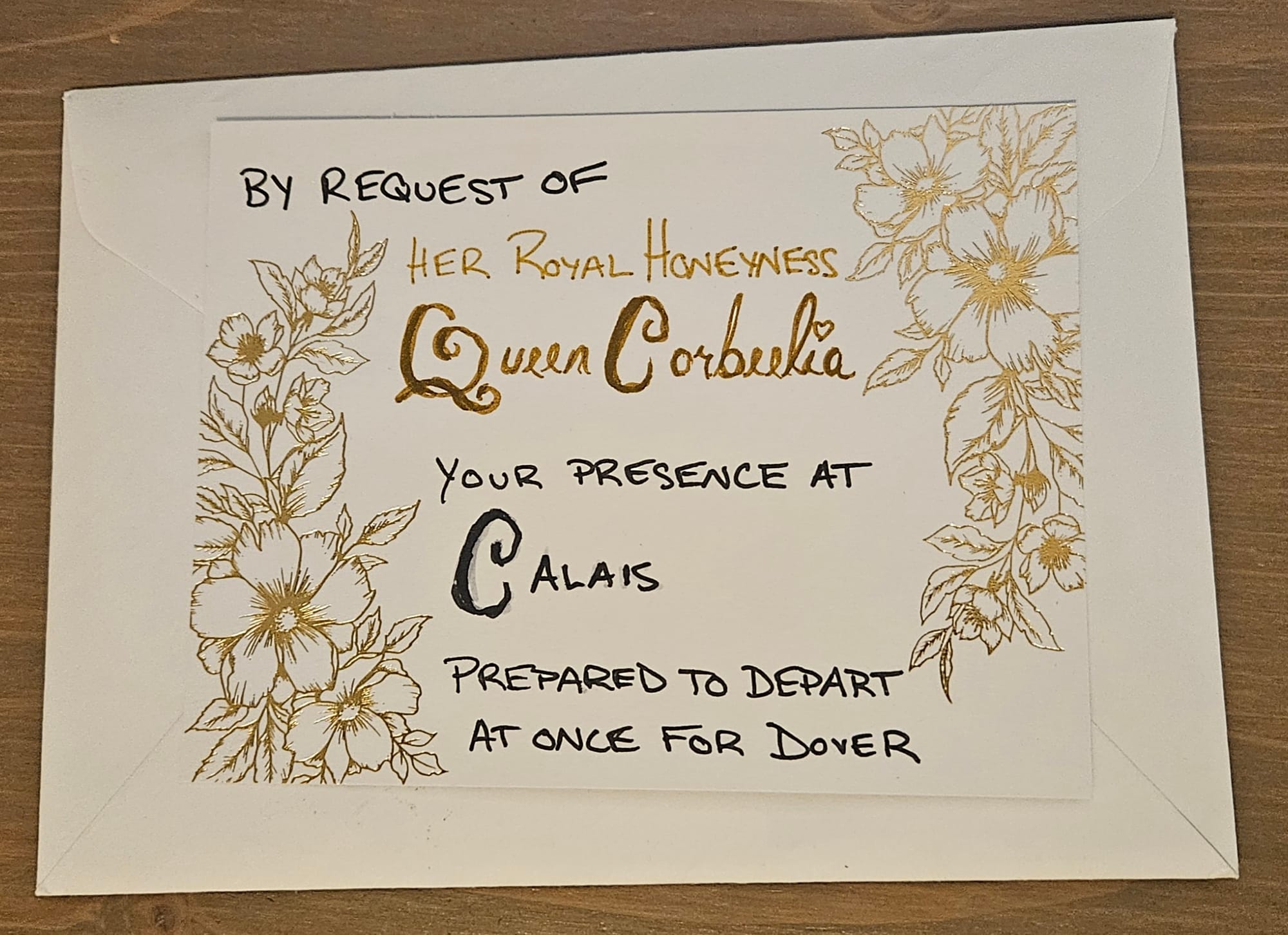
Normally, I am a player in the weekly D&D campaign, but on my birthday, I swap places with the game master. It’s my birthday, and I love puns, so I run the Honey Heist system every year where I get to make as many horrible puns as possible. (Well, I get to make as many puns as possible normally, I just usually sneak them in. This is loud and proud, inescapable punning for one day, you see.)
Some years ago, I started taking an actor’s table-reading class on Shakespeare. Not because I want to be an actor, but because it’s just a different way to stretch my brain on a topic I already love. I take its lessons and apply it to my own character motivations and roleplaying at the table.
Most years I take the class, I cannot shut up about it. Particularly, the year it was on Macbeth, my table of friends could not stop pointing out, “hey, since you enjoy it and are deeply into it, why don’t you do MacBear for the next Bearthday Party?”
So it’s become a Shakesbearean Heist each year since. Currently, I have half a year to come up with a satisfying bear/honey/bee pun for Hamlet. I have the pun already for Romeo and Juliet. I could just have the Bears assist Rawrmeo against my Beeliette. But I want to actually attempt the dream of a split-table PvP Heist, and I’m so not ready to build that yet. So Hamlet it is.
At one point, one of my friends asked whether I was going to run out of Shakespeare plays for my Bearthday Honey Heist one-shots. Not as a comment on my adaptation skills, I think, but out of an honest unease of not knowing how many Shakespeare plays there are.
That some year soon, I would possibly run out of content to adapt.
Friend cannot be the operative word in the compound friendslop. I reject that synonyms would be "friendlike" or "friendcore" because honestly, why not co-op?, lobby-style?, MMO?, party?, squad?, neighbors on your island? There are any number of synonyms for friendly multiplayer, but the genre tag the game critics are using is friendslop.
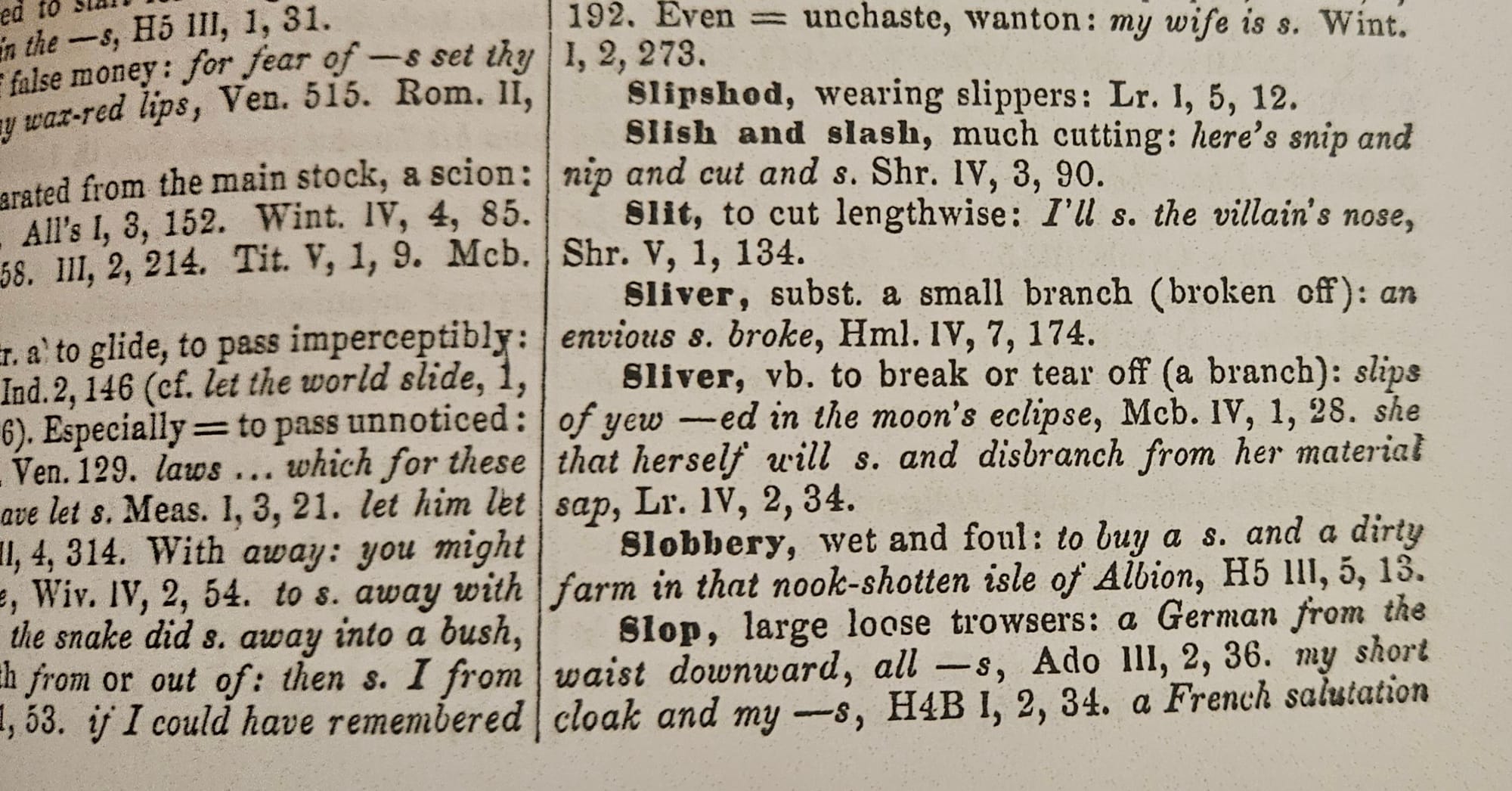
The main dictionaries in the English language—the UK’s Oxford English Dictionary and the US’s Merriam-Webster—are both descriptive dictionaries. In English, words’ definitions are tuned to how they are currently used in current texts, with historical footnotes on perhaps what they once were. Maybe friendslop started as Gen Z slang, but in the [both historical and current] thieving fashion of Modern English, it’s been changed from its slang meaning already. The slop has since taken over the main connotation for the word.
Slop is content for infinite content’s sake. Slop is ground-up leftovers for calories of continued existence, not for any kind of tasting. Slang drips with taste. Spicy, biting, tart & sharp, a specific and instantly recognizable dish: teenage/young adult critique of a universal human struggle to fit in that hits you deep to your core. Forever anchored to specific years and cohorts of style and society. The infinitely-repeating youthful reinvention of a single word to cover some slice of “Thou art the thing itself”, one of the-character Lear’s famous lines, Act 3 Scene 4.
Maybe I am simply not hip to the Gen Z register of English, but the only place I really see the full term friendslop is in games journalism. It’s wielded like a term that looks in on, and with slop’s connotations to AI, down on.
Friendslop reads: I paid for this game and all I got was a good time hanging out in voice/chat with my friends, which is an experience I could have without this game. This game itself did not converse with me, with us. This game is just wasting my, and my friends', time and money.
When the Bearthday Party met the already-blinded, -bloodied, -bandaged bear at the top of the cliffs, and asked how they could help him, I responded with Gloucester’s request as it is in the play-actual:
There is a cliff, whose high and bending head
Looks fearfully in the confinèd deep.
Bring me but to the very brim of it,
And I'll repair the misery thou dost bear
With something rich about me. From that place
I shall no leading need.
Gloucester
King Lear: Act 4 Scene 1, lines ~83-88
Most times one reads the play, when Gloucester says "something rich about me," he means money. He'll pay anybody to, y'know, show him where to go, so he can [euphemism tone:] “stop wasting his time”.
Gloucester’s request is the same main goal as in Peak, I've read. Though, admittedly, Gloucester's is from the distressing descending perspective, and Peak's is from a hopeful ascending one.
There is no story or narrative but there is “lore” if you like that sort of thing (that is, narrative which is written to be ignored without consequence). There is no overarching plot or true “main story,” but there are a handful of maps with unique features and tweakable settings, so endless replayability is baked into the game design. That endless replayability is only further strengthened by the inherent randomness of both the game itself and the chaos of co-op multiplayer.
This is but one element of friendslop.
(Lotus's essay)
In King Bear, the table Bears did the play's scenes out of order. In retrospect, this irreparably fucked up running the play as itself, while simultaneously opening up all the great new-story opportunities that come only by listening to and trusting in my friends.
I had panicked, to be honest. The previous year, I did A Midwinter Day’s Heist for many reasons, like I noticed in class that I could lift straight out the largely off-stage “Bottom’s Quest” of the honey-bag from the red-hipped humble-bee, but also that it was the favorite play of one of my friends. King Lear was requested solely on the pun the title made. I hadn't planned very well how to do a whole play this time, let alone one of the Great Tragedies.
I suppose I could've just MacBear'd it again: send the Bears to heist King Lear and Cordelia from their imprisonment in the final, fifth act, and drop references to scenes from acts one through four.
But that misses out on the whole Edgar/Edmund/Gloucester bits, and even leaves out Regan and Goneril to a point. Just rescuing Cordelia skips all her power scenes, from defying her father to returning for him at the head of French forces. And what of Gentleman and First Servant? Some of the crucial if nameless small roles, gone to "skip cinematic"?
One crucial aspect of my Shakesbearean design is I don’t demand my friends read the plays. I want to show them my love of it, but without forcing it like homework on them. I’m here to let my friends shred a Shakespeare play in the funniest way possible.
I explained that King Lear had been so sad and disturbing that historically the play's had a few different endings, just to make it happier. I dared them to make it outright funny this time. I wanted their shared time, their "stupid", didn't-read-the-play-once ideas about how stuff in this play should go, and their laughter. I wasn’t there to get the play "right", just to see what bonkers version we’d come up with.
As it turns out, the Bard’s stuff is quite resilient. My friends, having never read King Lear before, without being hinted at or quested for, managed to replicate several of the play’s event-conclusions to their specific actions.
One defining feature of friendslop that I don’t see mentioned much is how it seems to always be some kind of generic open-world game that just… exists. Separate of the friends, even opposite to. Its compound word is not hyphenated or spaced, co-existing, balanced, but slapped together.
The opposite of “open world” in gaming is usually some kind of railroaded or otherwise strict story-line where the player follows content rather than creates it. Friendslop has cooperation, yes, and its worlds are interactable with, but the world still exists to be solved in a finite way, rather than created alongside. The worlds that friendslop games inhabit are partitioned-off generic Somewheres.
Peak has an airplane crash somewhere at the foot of some mountain. The train in Big Walk goes somewhere in all of the nature and civilization from some non-descript anywhere. Lethal Company is scavenging some moon for some Company. Content Warning is some outside real-like world, filmed for some fictional digital world consumption. R.E.P.O. … is a horror game and horror actually works better if the player’s imagination is running the specifics, so that’s fair, don’t tell me where that one is.
Once you solve a friendslop game’s puzzles, do you ever go back? Why? The world itself in a friendslop does not make a lasting impact. It doesn’t matter to that world that you were ever there. Log in, log out.
You could play D&D like it’s a set number of puzzles and quests to do; power gamers exist. There are power gamers in the lets-plays of friendslop games, sneering in proximity voice at people who have never played the puzzles before. It’s a world that can be min-maxed.
But the main difference between something like D&D and friendslop is that a friendslop world does not listen back. Which is what my depression tells me—your friends aren’t listening anymore because you’re so selfish and stuck-up. I think that’s what’s distressing for me about the term. It expresses to me that there's no there, there.
In TTRPGs, I create for my friends and they create back; we create together. The game does not work if we don’t listen to each other. The game master can create all the lore they like, but none of it is real until the table asks about it. The world in friendslop may encourage friendly play, but it does not demand the double-sideness of friendship the way that other friend-based games do. Friend is part of the word, but not at all crucial to its form. Neutrally co-op slop, more like.
During King Bear, I confessed to the table that, haha, Choices Were Unfortunately Made when I plucked out blinded Gloucester, and that I’d need a moment to think my way out of the plot corner I panic-ran myself into.
The usual game master laughed, and said, “you know that’s all I do behind the screen, also? Panic and improvise.”
“But, you do it so confidently.”
“HEY LISTEN TO ME—we are the same.”
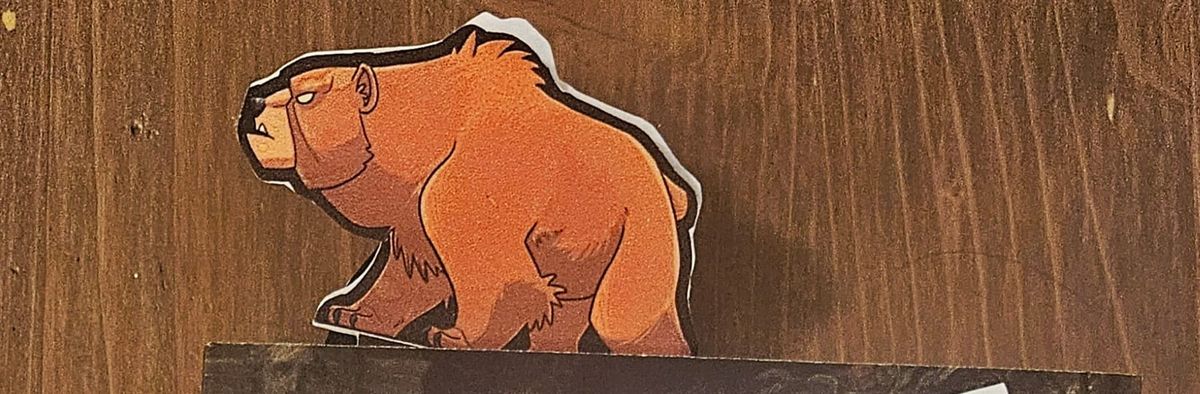
![A paper figurine of a brown, grumpy grizzly bear stuck as a bookmark in a copy of Shakespeare's A Midsummer Night's Dream in German. A black-text-on-white unstuck sticker lies on top: [exit, pursued by a bear].](https://storage.ghost.io/c/89/f1/89f14c62-5673-4dcf-85ae-dd8fa6ade759/content/images/2026/08/exit-pursued-by-a-bear.jpg)
In the play, Gloucester's son, Edgar, is the one to take Gloucester's request up. Gloucester's goodly son, put out into hiding by bad-brotherly rumors of dishonoring his father. Gloucester's son, putting on a madman's voice and dirt-rolling, houseless disguise, fully aware and confessing in plural asides to the audience that this is his father he's leading to wanted-and-unwanted death. Last Edgar physically saw his father, Gloucester had both eyes still.
Five scenes later, we find Edgar choosing to lie.
GLOUCESTER:
When shall I come to th' top of that same hill?
EDGAR (as Poor Tom):
You do climb it now. Look how we labor.
GLOUCESTER:
Methinks the ground is even.
EDGAR (as Poor Tom):
Horrible steep.
Edgar sets the scene in words and lets the old man do that forgot-a-stairstep kind of fall from a five-steps-up kind of height. Edgar bids a calm farewell before the step-off, only to quickly move around to the "far below" side, and then he puts on another vocal affect of a different stranger to exclaim that Gloucester survived the fall. "Thy life's a miracle. Speak yet again." Edgar convinces Gloucester that the devil led him to the cliffs to die, therefore, in opposing the devil, he must continue to live.
The Bears achieved the same outcome—Clawster lived; in the same way—by lying about it. But they told a different lie than Edgar. When they first met Clawster, they were coming from the cliffs, and he was facing them. This is a game with two stats: Bear and Criminal. All they had to do was confirm he was already on the right way, and then... let Clawster go.
Back in the intensely pandemic times, class had only discussed the tragedy of the moment: watching a parent deteriorate and die. It's all over the play in both major families, at least. Reading the play in full or seeing a proper stage production, you really can't avoid it. I didn't intend to set my friends up like this. It just was already happening before I really thought about what I’d set.
Except, fortunately for me, I'd run the play out of order. This is the first proper scene of the play that the Bears had met. And nobody but me had read it before.
The Bears hadn't met Edbear yet, and they didn't know about Edmawnd's plot. They hadn't even yet seen mad, naturally-naked King Bear and his Fool with Kent on the heath. They didn't know that Cornmaul clawed out one eye, and, after slaying the protesting First Servant, now on the urging of Regan, clawed out the other.
The Bears knew Clawster only as a strange, fellow bear, played by their birthday friend at the table. So they acted accordingly. As old-new friends would when their friend cannot be wordily persuaded away from a harmful goal.
They put gentle paws on his shoulders, gave him some honey stash for the journey, and lied with great affect that Clawster must've gotten turned around, or been given bad directions. No, no, no, good sir, please, you want to go this [totally different] way.
They specified to me, out of character, that despite whatever mapmaking technology of the time, they definitely pointed him in precisely the longest possible land route through Britain. Double-, triple-checking on phones that Dover is at the southeastern butt end of Britain, pointing him up to Scotland's northwestern cap's point, please please please. One of the bears tried to give convoluted directions that definitely sent Clawster in some circles, too, but then was dissuaded. (“What if he gives up on those directions while going straight off of Wales?” “Awww yeah, you’re right, simple is probably best.”) Where we are in the world isn’t just about being here now, but that we can’t simply leave later without affecting anything.
Later the Bears asked about him: is he still walking? Did he run into anything yet? I assured my friends that we did not need a two-shot to make sure Clawster lives. That Gloucester lives in the play, too, and that Edgar also lied.
Edgar resolved Gloucester by crafting the details of Gloucester’s intended goal into a specific direction. He set a scenario with only one action to do, avoiding destructive failure. But it only works if Gloucester must depend on and follow Edgar’s telling of it, that he can’t see the true height of the “cliff”.
The Bears didn’t bother to question the theoretical ground our avatars all stood on. They didn’t force Clawster into anything. They resolved Clawster anyway by showing him that he had all the time he needed to decide differently for himself. There's no action or time wasted in friendship, lifelong or briefly. There’s no puzzle to solve.
Trade the hi in friendship for a lo? “Never, never, never, never, never.” (V.iii.~372)